
Post: Assignment #1
Assignment #1: Cultural Heritage by the Numbers
The the data from the file ‘All_culture_information.csv’ reveals significant disparities in the distribution of objects across different cultural categories. Out of the 254 rows, it is evident that American, German, French, Italian, British, and Japanese objects dominate the collection, with each category containing more than ten thousand objects. Byzantine, Greek, Chinese, Roman, and Dutch artifacts are also well-represented, with each category having more than five thousand objects. Conversely, certain cultures, such as Lebanese, Baule, Central African, Turkistan, and Yemeni, are notably underrepresented, with only one piece each in the collection.
Historical Significance: Countries like America, Germany, France, Italy, Britain, Japan, Byzantine, Greece, China, Rome, and the Netherlands have rich cultural and artistic histories that have produced a significant number of artworks over the centuries. These countries have been centers of artistic production and patronage, leading to a large number of artworks being created and preserved.
Colonialism and Imperialism: The dominance of certain countries in the museum’s collection may reflect historical processes such as colonialism and imperialism. Countries like Britain, France, and Italy had extensive colonial empires, which allowed them to acquire artworks from the regions they colonized. This resulted in a disproportionate number of objects from these countries compared to others.
Cultural Exchange and Trade: Countries that were major centers of trade and cultural exchange, such as Italy during the Renaissance and Japan during the Edo period, likely produced a large number of artworks that were traded internationally. This would explain the abundance of Italian and Japanese objects in the collection.
Preservation Efforts: Some countries may have had more robust efforts to preserve their cultural heritage, leading to a larger number of artworks being available for acquisition by institutions like the Harvard Art Museum. Countries like America, Germany, France, and Britain have well-established museum systems and cultural institutions that actively collect and preserve artworks.
Accessibility and Availability: The limited representation of certain countries like Lebanon, Baule, Central African, Turkistan, and Yemeni could be attributed to factors such as accessibility and availability. Artworks from these regions may be less accessible due to political instability, limited resources for preservation, or challenges in acquiring them through legal channels.
Some of the Most Viewed Object
In terms of the most and least viewed objects, I searched Chinese and Czech in the noebook Harvard_API_All_objects.
The most viewed Chinese artifact is One of a Pair of Dragonhead Bangle Bracelets. This piece of jewelry, which has been viewed 527 times, was created between the 1850s and 1870s, and it was accessioned by the Harvard Art Museum in 1895
Jewelry in Chinese culture often carries deep symbolic meanings, reflecting themes such as wealth, status, and auspiciousness. Dragon motifs, commonly found in Chinese art and artifacts, symbolize power, strength, and good fortune. The dragonhead design of the bracelets likely signifies these auspicious qualities, making them culturally significant adornments.
The mid-19th century was a tumultuous period in Chinese history, characterized by internal rebellions, foreign invasions, and the decline of the Qing dynasty. The acquisition of the bracelets in 1895, amidst these historical events, may have symbolic significance, representing a connection to China’s rich cultural heritage amidst periods of change and upheaval.
The most viewed Czech artifact is Barrandov Terrace Restaurant. It’s a photograph taken by Jan Lauschmann in 1931.
The time period in which the photograph was taken, 1931, was a significant era in Czech history. This was during the interwar period, characterized by social, political, and cultural changes in Czechoslovakia. The image of the Barrandov Terrace Restaurant captures a snapshot of daily life and leisure activities during this dynamic period, making it historically intriguing to viewers interested in Czech history.
The Barrandov Terrace Restaurant was a prominent social and cultural hub in Prague during the early 20th century. It was frequented by artists, intellectuals, and members of high society, reflecting the vibrant cultural scene of the time. The photograph may hold cultural significance for Czech audiences nostalgic for the heyday of Prague’s café culture and social life.
Choice of Three Cultures
I chose American, Japnese and Chinese culture, as they are among the most prominent in terms of quantity in the museum’s collection.
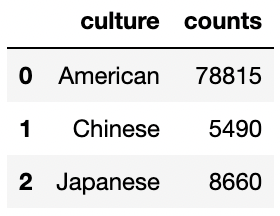
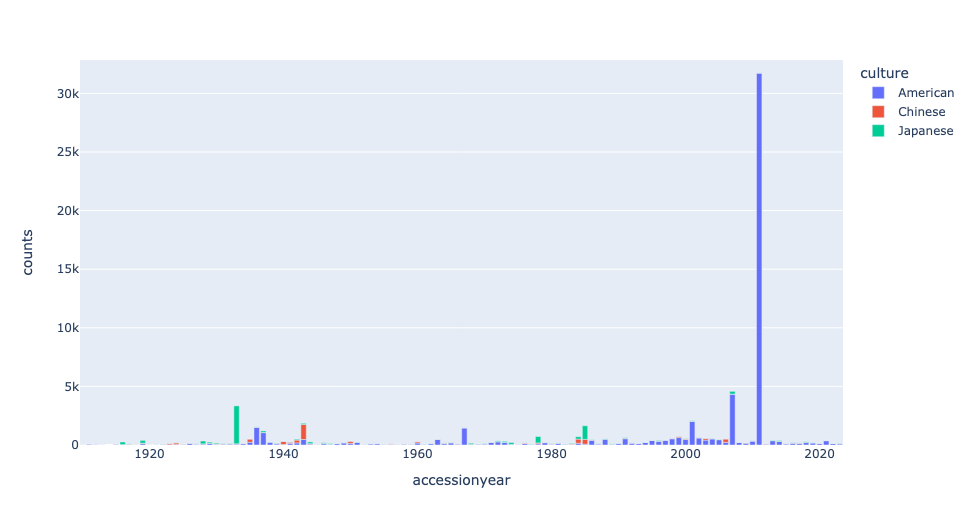
The peak in the number of American objects accessed in 2011 (31.74k) could reflect concerted efforts by the Harvard Art Museum to expand its American art collection or commemorate significant milestones in American cultural history. This period may have witnessed increased acquisitions of American artworks through purchases, donations, or bequests, driven by factors such as institutional initiatives, fundraising campaigns, or the availability of high-quality artworks on the market.
The fluctuating number of Japanese artifacts accessed in recent years, ranging from 1 to 21, may suggest variability in collecting priorities, availability of artworks, or institutional resources within the Harvard Art Museum during this period. Factors such as changes in curatorial focus, donor contributions, or the emergence of new scholarship on Japanese art could influence the acquisition decisions.
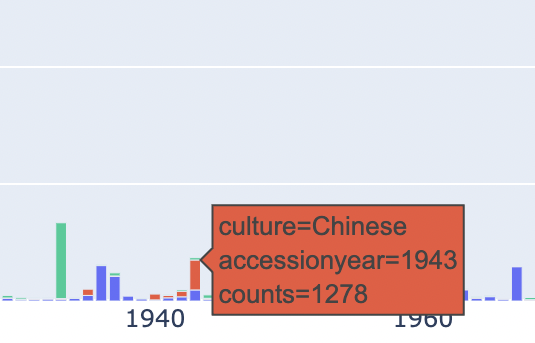
Very interestingly, most of the Chinese objects(1278 pieces) were accessed in 1943. The year 1943 falls within a tumultuous period in Chinese history marked by the Second Sino-Japanese War (1937-1945) and World War II (1939-1945). China was facing significant political upheaval, territorial conflict, and social disruption due to Japanese invasion and occupation in various regions. Despite these challenges, cultural preservation and national identity remained important priorities for many Chinese scholars, artists, and cultural institutions.
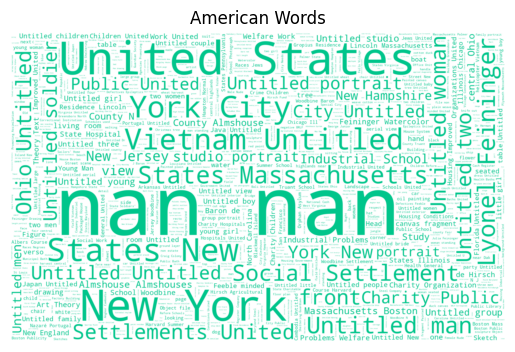
The word cloud for American artifacts in the Harvard Art Museum shows that certain geographical locations like “United States,” “New York,” “York,” and “States” are prominent, indicating a focus on American regions or cities. The appearance of “Massachusetts” and “Ohio” suggests that specific states within the U.S. are also significant in the collection. The inclusion of “Lyonel Feinger” likely refers to an artist or individual associated with the artworks, potentially indicating a notable figure or a significant contributor to the American art scene. Overall, the word cloud highlights geographical locations, specific states, and possibly influential artists within the context of American artifacts in the museum’s collection.
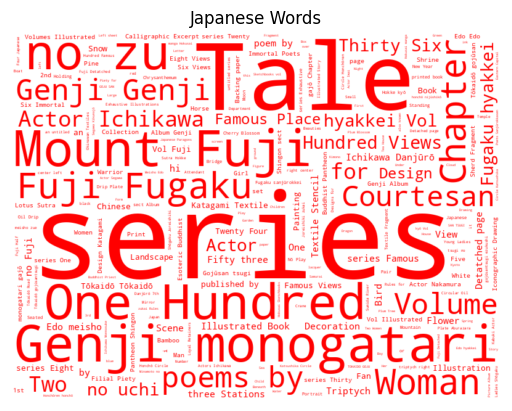
The word cloud for Japanese objects indicates a focus on literary themes and cultural motifs. The prominence of words like “Series” and “Tale” suggests a significant presence of narrative or series-based artworks. “Genji,” “Fuji,” and “Mount Fuji” are prominent, possibly indicating a focus on iconic Japanese landmarks or literary references like “The Tale of Genji.” The repetition of “Fuji” and “Genji” underscores their importance. Additionally, terms like “Woman,” “Poems,” “Ichikawa,” “Actor,” “Courtesan,” and “volume” suggest a diversity of subjects, including representations of women, theatrical themes, and literary volumes. Overall, the word cloud reflects a rich tapestry of Japanese cultural and literary influences in the museum’s collection.
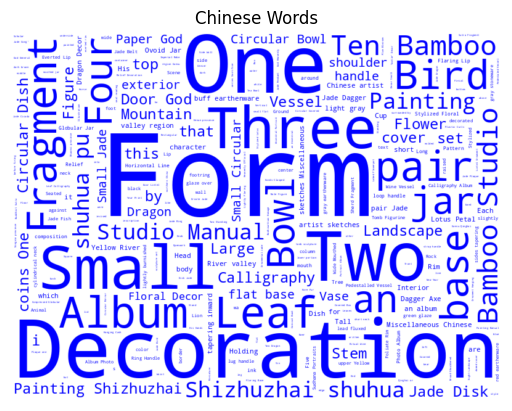
The word cloud for Chinese artifacts suggests a focus on form, decoration, and numerical symbolism. “Form” and “Decoration” being the largest words indicate an emphasis on the visual and ornamental aspects of the artifacts. The prominent numbers (“One,” “Three,” “Two,” “Four”) suggest numerical symbolism or possibly categorization within the collection. Additionally, the presence of terms like “birds,” “bamboo,” “flower,” “vase,” and “mountain” reflects the significance of nature and traditional Chinese motifs in the artworks. The appearance of “calligraphy,” “shuhua,” “Shizhuzhai,” and “Album leaf” indicates a strong presence of Chinese calligraphic and artistic traditions. Furthermore, the mention of specific items like “Circular Dish,” “Jade Disk,” and “Circular bowl” may highlight the Chinese aesthetic preference for circular shapes and forms. Overall, the word cloud reveals a diverse array of cultural and artistic themes within the Chinese artifact collection.
Ready for grading.